Tips ·
Technical equipment for surfing
Why the choice of technical equipment matters for correct, safe surfing, so that you can learn and progress.
Basic equipment
Modern foam and fibreglass surfboards are the result of more than 30 years of development. In the early 1950s, the manufacturing technique using fibreglass, polyurethane foam and polyester resin was perfected in California, with much of the credit going to the late Bob Simmons. Before that, balsa wood was shaped, producing surfboards much heavier than foam ones, which, when damaged, soaked up water and rotted.
Today, those first foam and fibreglass surfboards would be considered primitive, weighing between 15 and 20 kg. Surfboards kept a length of about 3 metres until 1965, when a young Australian, Bob McTavish, came up with a completely new design, with a V-shaped bottom. This made the surfboards much shorter and much easier to manoeuvre, and it began an era of change that saw surfboard length fall from 3 to 2 metres.
Surfing technique became quite different from the era of longer surfboards, when surfers had to be strong enough to move the surfboard through the breaking waves. If the surfer lost the surfboard on entering the water, or when riding the wave, they had to swim to the beach to recover it. The use of a chop, a cord or a leash, the line that attaches the surfboard to the surfer, would probably not have been practical, because of the surfboard's huge volume and weight; the surfer would probably have lost a leg if the surfboard broke free with any force.
Today, surfers have light surfboards, a leash to attach them, and suitable wetsuits. As equipment has developed, the range of choice has widened a great deal, which in turn leads to some confusion when a beginner walks into a shop full of surfboards, wetsuits and accessories. The basic item you need in order to surf is obviously the surfboard.
Other essential items are wax, a pair of shorts, and the leash that links you to the surfboard. Where you surf, and the time of year you plan to do it, may dictate whether you need a wetsuit.
Surfboards
The core of the surfboard (the blank) is made of polyurethane foam. These cores are manufactured in different lengths and widths, and they generally have a thin layer of balsa wood through the middle, to increase strength and stiffness.
The core is then worked into its final shape. This is the most specialised job in the factory, and the workers who do it are often good surfers, able to transfer their surfing knowledge to the surfboard they make. The core is marked and cut using a template, then levelled with an electric tool that removes the roughness of the outer surface. The rails, or edges, are cut using the same machine, and the surfboard is then finished with sandpaper.
After the core is finished, it is painted using cellulose paints. Surfboards can be made to the customer's taste for a slightly higher price. The outer finish is not a functional part of the surfboard; it is purely cosmetic, and it obviously will not make you surf better.

Next, the core is laminated with a layer of fibreglass in order to protect the foam, which is quite fragile. Sandpaper is used again to remove the roughness of the fibreglass. This must be done with great care, so as not to sand away the outer fibreglass shell.
Surfboards can also be moulded. The same process already described is used to create an "original" surfboard, and a mould is then cast from its shape. Foam is then poured into the mould, producing surfboards identical to the original.
Learning to surf is made much easier when you choose the most suitable equipment. From the start, think of the surfboard as a platform that will keep you on the waves.
Beginner surfboards, unlike those used by professionals, should be long, wider and thicker. Unfortunately there is no formula you can apply to calculate the ideal length, thickness and width according to a person's weight or level of experience.
Your choice of equipment will determine how quickly you can master the basics of paddling while lying on the surfboard, and of balance on it.
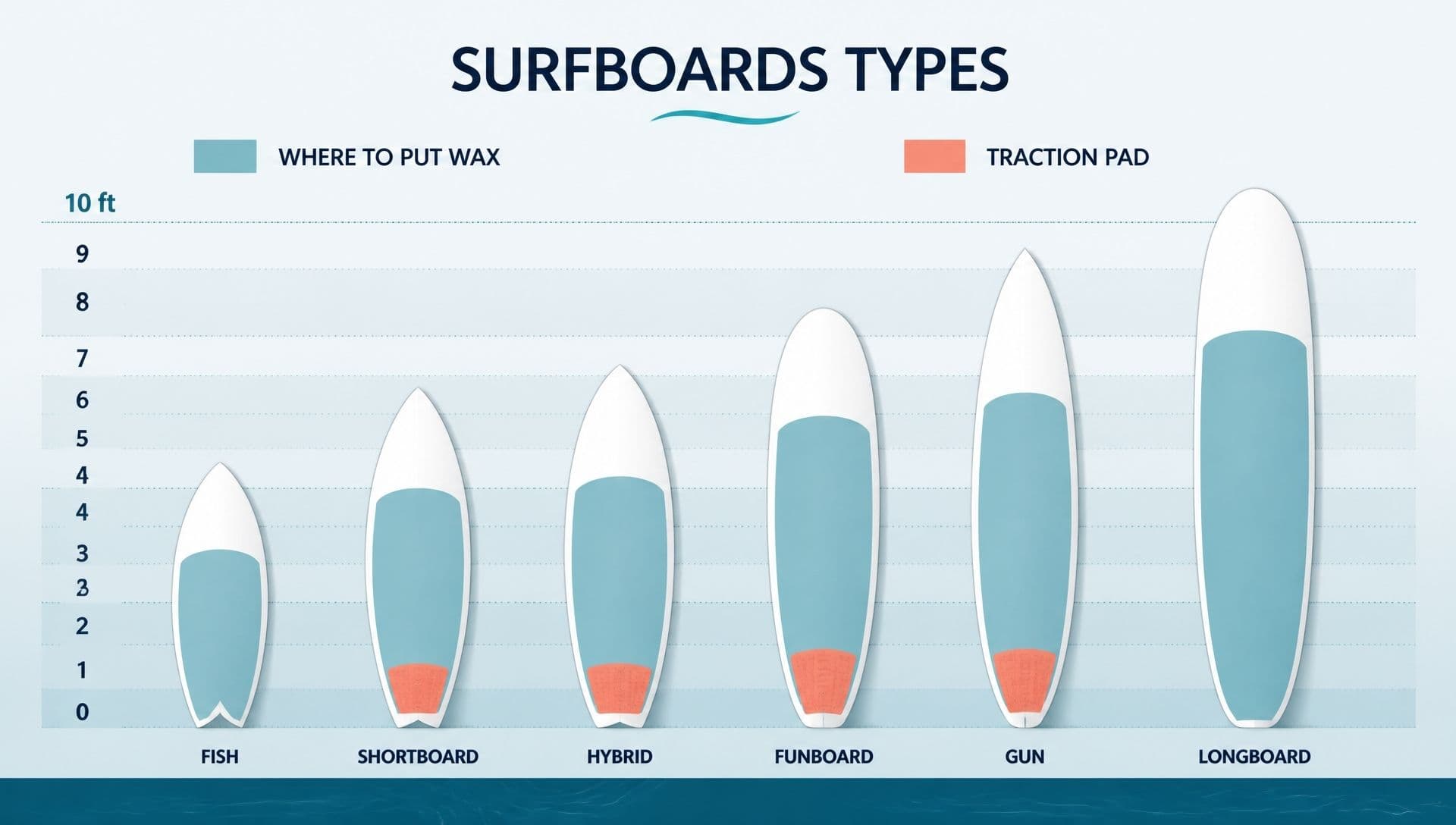
Surfboards come in every shape and size and, like golf clubs, they are designed for a specific task. A beginner surfboard, depending on the person's weight, ranges from 2 to 2.5 m in length, is about 55 cm wide, and ranges from 10 to 15 cm in thickness. The outline, or outer shape, should be wider at the nose and at the tail, so as to form a stable platform.
It is much easier to master the basics of this sport on a stable platform with plenty of flotation. A beginner's surfboard may not look as slender and short as the models for veterans, but you can be sure that you will learn the sport much faster than if you use one of those.
The money you can spend on the surfboard obviously dictates the type you buy. It is important to know the options best suited to learning to surf. Look carefully at made-to-measure surfboards, moulded surfboards and second-hand surfboards. Do not let yourself be persuaded to buy a surfboard only because it looks like a good deal and because it is the fastest way to get equipped.
A handmade or made-to-measure surfboard costs more than mass-produced ones, but for learning to surf either can be good. The first are much lighter than the second; that makes them more prone to small holes in the outer fibreglass. Moulded surfboards are "standardised". They are produced in various lengths, widths and thicknesses, and built from fibre-reinforced plastic.
They are more durable and will cope perfectly well with the many falls a beginner will have at the start. To help you choose, it is important to look at these types of surfboard in more detail.
Made-to-measure surfboards
Buying a surfboard of this type starts with a visit to the factory, or the shop that takes orders, where you can count on the help of a specialist. If possible, it is always better to go to the factory, where you can speak to the person who will actually build your surfboard. That person will want to know your weight, your height and your ability as a surfer.
Once they have this information, they can give an opinion on the surfboard's shape and its dimensions. This way of ordering is used by surfers at every level, including the best professionals.
Once the dimensions are set, you can choose the decoration you prefer.
It is a little like buying a new car: every accessory is expensive, so try not to overdo it. If you learn quickly on your beginner surfboard, it will not be long before you want to change it for a more advanced model, and the design you consider very artistic may deter anyone who might want it. In my experience, beginners do not much like to draw attention to themselves, so they generally prefer surfboards with simple decoration. In any case, the colour of your surfboard will not help you learn to surf, nor will it make the surfboard work better.
When you place an order, you will be asked how many fins you want on the surfboard. More advanced designs, with different fin configurations, certainly give better results when used by professionals; but your first surfboard should be able to move well along a controlled line, and a single centre fin solves this problem adequately.
When you order a surfboard, you have to wait some time for it. For the impatient, factories produce "made-to-measure" surfboards that are already made.
Share